

11 May 2026
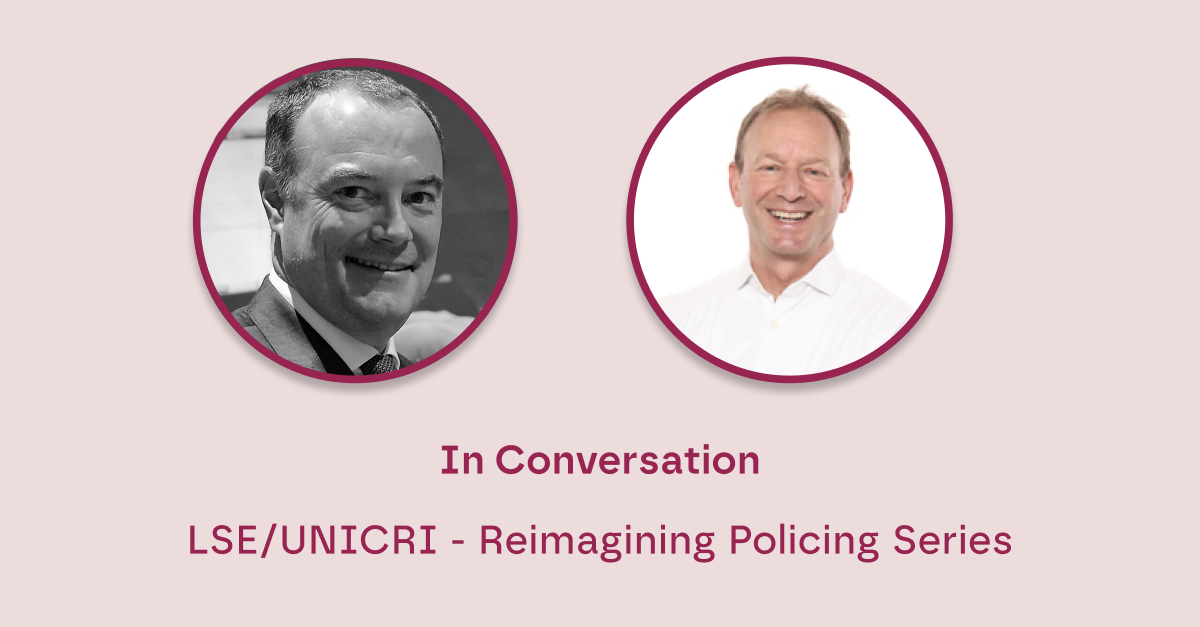
A conversation with Prof. Tom Kirchmaier (London School of Economics - LSE) and Mick O’Connell (United Nations Interregional Crime and Justice Research Institute - UNICRI), by Dick van Veldhuizen (Roseman Labs).
There is a paradox at the heart of modern public safety. We collect more data and deploy better technology than at any point in human history, and yet agencies remain less equipped to act on that data than the scale of it should allow. Fragmentation means that what they know individually rarely becomes what they could know, or act on, collectively.
A landmark series of papers by the London School of Economics and UNICRI makes the case for a fundamental shift. For the first time, agencies can share what they know without exposing what they hold. The privacy-enhancing technology to do so is there. The legal frameworks are increasingly in place. What the papers set out to build is the architecture that brings it together.
I spoke with the co-authors, Professor Tom Kirchmaier, Director of the Policing and Crime research group at LSE’s Centre for Economic Performance, who has spent over two decades working empirically with police data across Europe, and Mick O'Connell, who spent over three decades in senior law enforcement roles in the UK and internationally, including as Director of Operational Support and Analysis at INTERPOL, and now works on policing reform and responsible AI internationally.
A fundamental mismatch
"How serious is the gap between how threats operate today and how institutions are structured to respond?"
“The current situation is not optimised for today’s data environment,” O’Connell says. Policing organisations are, by design, conservative institutions, built around legislative frameworks and governance structures that predate the digital age. “We end up with a fragmented intelligence picture. Missed interventions. Confused decision making, or no decision making at all.”
“If you don’t use the data, there’s no progress,” Kirchmaier says. The architecture of public services was built to protect data silos, and it has. Meanwhile, organised crime faces none of these constraints. “They’re super agile, super intuitive,” O’Connell says, “in the way they use intelligence and data to attack on many fronts. But the institutions are misaligned.” That asymmetry, he argues, produces adversary advantage.
Why it has proved so hard to fix
The obvious question is: if the problem is so clear, why has it not been solved?
Data sharing, Kirchmaier argues, remains the exception rather than the rule. “Partly because there’s no culture, partly because there’s no understanding of what is actually required.” What sharing does happen tends to be partial, slow and bilateral rather than structural. But it goes deeper than that. Fear of accountability, dressed up as caution, has persisted long after the legal basis for sharing was established.
O’Connell points to something structural as well. The entire architecture of data management was designed around keeping information private and secure, rather than sharing it. “Our mechanisms were designed to firewall information, not enable its sharing.” The dilemma was real: to share an insight, institutions felt they had to share the underlying data. Since that created legal and political exposure, the rational response was to share as little as possible.
“I don’t think we’re at a liberty anymore,” O’Connell says. “We’re beyond that tipping point. It’s a fundamental imperative. And for the first time, the technology exists that makes it possible to act on that imperative without the risks that held us back.”
A platform, not a panopticon
“The papers don’t stop at diagnosis. They propose a concrete framework for moving beyond it. What does that look like in practice?”
“What we’re proposing,” O’Connell explains, “is what we call a Civil Public Safety Platform. A governance architecture that makes multi-agency collaboration and data sharing technically possible and institutionally trustworthy. Police, health, education, probation, border agencies, intelligence services, each contributing toward a shared picture, each retaining full control of their own data. The organising principle is the citizen and their needs, not institutional ownership of information.”
“The minute you merge data together,” Kirchmaier adds, “you get a picture you have never seen before. About problems with people, about problems with areas, about families. And that enables you to help them in a way they need help.” What the platform is not, matters as much as what it is.
“We’re not prescribing an Orwellian super surveillance state,” O’Connell says. The platform is not a central repository, not a database of databases, not one agency acquiring dominion over the others. It is a shift from siloed institutions to a data-enabled public safety ecosystem, where the purpose of sharing is not institutional power but collective response.
The cost of the current arrangement falls directly on the people these institutions exist to serve. “We actually actively deny them the right to be helped,” Kirchmaier says. “We deny them the help they need because we can’t connect the dots.”
The missing piece: PETs
“In Paper 3 you identify Privacy-Enhancing Technologies as the single most important technical enabler. Why?”
“We always come back to the same denominator,” O’Connell says. “Can I be confident that if I share information with you, it will be used for the purpose for which I shared it?” It is a question that has blocked progress for decades, and one that, until recently, had no satisfactory technical answer.
"That changes things fundamentally for senior leaders," he continues, "who are ultimately responsible for the information they hold. A new architecture can be put in place that allows PETs, with their ability to prevent underlying information from being exposed, to allow pertinent information that is lawful and appropriate to be shared, both in real time and in slower analytical settings."
The implication is significant. Where governance once depended entirely on human agreement, protocols, memoranda of understanding, data sharing arrangements, the architecture itself now enforces the rules. "We were scared that if we had to release one piece of information, we had to release all the underlying information, which was not appropriate. We don't have to do that anymore."
That changes what trust means in practice. "Technology can actually drive trust, assurance, good governance," O'Connell says, "as opposed to it being just the sole reliance of humans and paper-based processes. When we understand that it works, it can be transformational. It can unlock those inhibitors that were there before."
But deploying the technology is only part of the challenge. "This is not about placing a PET on top of a silo. If it's a fundamental shift, we've got to go through those cultural decompression points and get to a position where we are working as a collective. Trust is hard won and easily lost. If the technology enforces it, we no longer have to rely on goodwill alone."
“I couldn’t agree more,” Kirchmaier says.
How to begin
“A senior leader reads this and is ready to act. Where do they start?”
“Just do it,” Kirchmaier says. “Start somewhere. Have a platform you trust, build on it, and get more and more people in. Nobody can see the benefits yet because we haven’t shown them. Once you do, the dynamics change.”
The governance framework the papers provide makes the starting point clear. “It’s almost like a tick box,” Kirchmaier says. “Once you’re through it, there’s no reason why you can’t share. The argument needs to be the other way around: not why do I share, why do I not share?”
O’Connell describes a practical path. “We’re able now to take people, particularly policymakers and police chiefs, with us on a journey in a very controlled, professional environment to prove how these sorts of technologies can work.” Sandboxes. Pilots. Specific use cases with demonstrable outcomes. Not a radical transformation but a managed flight path, one that “makes society safer, helps victims or people at risk get quicker, more informed responses.”
The cost of not starting is also concrete. “The way we’re structured at the minute, we can’t afford to protect our communities carrying on the way we have.” The current fragmented model is not only less effective, but also increasingly unaffordable. “Something has to give,” O’Connell says. “And at the minute, what’s giving is victim’s needs.”
Read the Reimagining Policing Series here: https://info.lse.ac.uk/staff/divisions/research-and-innovation/innovation-and-impact/Reimagining-Policing
Generate new insights on sensitive data with Roseman Labs’ secure Multi-Party Computation technology. Want to find out how your organization can do that? Contact us using the form below.
Newsroom